
Money doesn’t always create problems in big, dramatic ways.
Sometimes, it begins with something very small.
👉 money mistakes people ignore
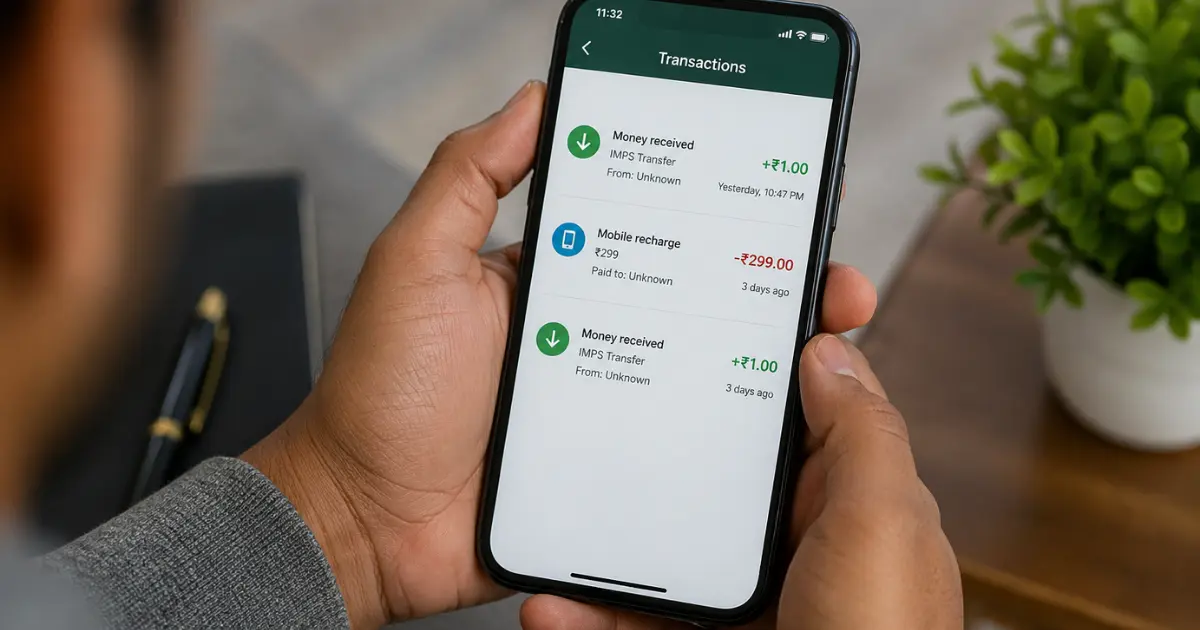
A few days ago, I received a message and a WhatsApp request from an unknown person. He said he had mistakenly recharged my mobile number with ₹299 and requested me to return the money.
At first, it sounded unusual. But I checked my phone, and the recharge was actually done.
It felt genuine.
There was no pressure, no threat—just a simple request.
So I did what most people would do in that situation.
I returned ₹299 by scanning the QR code he shared.
The matter seemed closed.
But yesterday, something unexpected happened.
I received ₹1 in my bank account through IMPS—from someone I do not know.
No message. No explanation.
Just ₹1.
When Small Things Don’t Feel So Small
Individually, both incidents look harmless.
- A mistaken recharge
- A ₹1 transfer
But when they happen close together, they raise a quiet question:
Is this just a coincidence, or something more?
This is where most people ignore the situation.
Because nothing “serious” has happened yet.
No big loss. No obvious fraud.
But money problems rarely begin with big mistakes.
They begin quietly—through small actions we don’t question.
The Way We Think Matters More Than the Money
Looking back, I realised something important.
My decision to return ₹299 was not based on careful verification.
It was based on trust and emotion.
- The request sounded genuine
- The recharge actually happened
- The amount was small
So I acted quickly.
But money decisions are not just about whether something looks right.
They are about whether we pause and think clearly before acting.
Because in today’s digital world, even small transactions can be used to:
- Test if your number is active
- Check if you respond to unknown requests
- Build trust before attempting something bigger
And sometimes, even a ₹1 transfer can be a way to verify your account.
What appears small and harmless at first can quietly become part of something larger—if we don’t pay attention.
When Trust Is Misused
This reminded me of another incident.
One of my former colleagues once received a call from someone claiming to be from the bank. The caller said they were verifying customer details and asked him to share an OTP that he had just received.
The conversation sounded normal. There was no urgency, no obvious threat.
Unaware of the hidden risk, he shared the OTP.
A little later, he received a message from the bank.
₹10,000 had been debited from his account.
There was no mistake this time.
No confusion.
Just a simple action—taken in trust—leading to a real loss.
The Part Most People Miss
Not every such situation is a scam.
Sometimes, mistakes do happen.
But the real issue is not whether the other person is right or wrong.
The real issue is this:
Are we making money decisions calmly—or reacting instantly?
Most people don’t lose money because of one big wrong decision.
They lose it through a series of small, unexamined actions.
- Sending money because it “feels right”
- Trusting because the amount is small
- Sharing details because the situation sounds normal
And by the time something feels wrong, it is already too late.
How I Would Handle It Now
If I ever face something like this again, I know I would respond differently.
Not with fear. Not with urgency. But with a little more awareness.
I would not send money directly to an unknown person—even if the situation appears genuine.
Instead, I would prefer to inform the bank and let the process happen through the right channel.
I would not scan QR codes shared by strangers.
And I would never share an OTP—no matter how normal the conversation sounds.
Most importantly, I would give myself time.
Because in many situations, the real risk is not in the money itself,
but in the speed of our response.
A small pause can often prevent a bigger mistake.
A Simple Thought to Remember
Money decisions are not always about big investments or large amounts.
👉 Everyday money decisions that shape our lives
Sometimes, they are about how we respond to small, unexpected situations.
A ₹299 recharge.
A ₹1 transfer.
A simple phone call.
Nothing significant on the surface.
But enough to remind me of something simple:
And perhaps, in such moments, what we need is not quick action—but quiet clarity.
Not every situation needs an immediate response. And not every request deserves instant trust.
In a world where money moves instantly,
the smartest decision is often to slow down.
Have a Money Question?
Share your financial dilemma. Your question may become a helpful guide for others too.
About the Author
Naivedyanandan Sonowal is a former teacher and former APDCL professional who now works as a freelance journalist. He writes about real-life money decisions shaped by experience. Having managed loans, debt, and financial responsibilities firsthand, he shares practical insights to help readers think clearly before they spend, borrow, or invest. He is also the author of a book on smart retirement planning, available on Amazon.
👉 Read my story →