
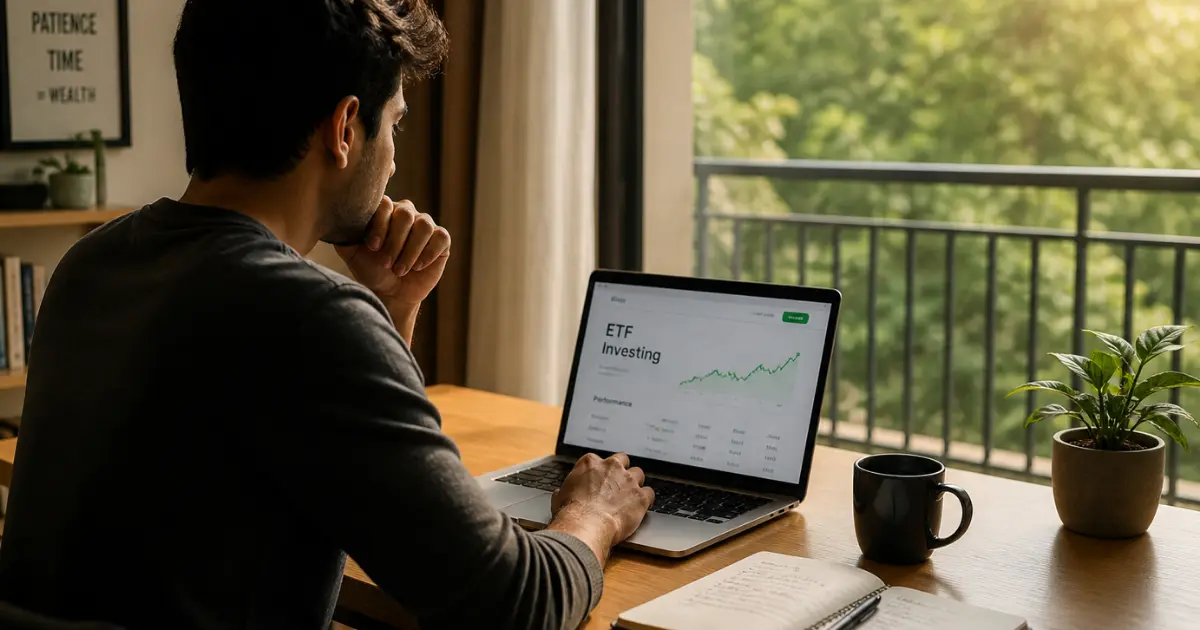
Most people think about investing, but they don’t know where or how to start.
If you are one of them, this article is for you.
There comes a moment when you decide to move beyond saving and step into investing—
not for quick gains, not for excitement, but for something quieter and more meaningful:
to let your money grow while you focus on living your life.
For many beginners, broad-market ETFs can be a simple way to start investing while gaining diversification.
But “simple” does not mean “obvious.”
You still need clarity—so that your first step is steady, not confusing.
Let’s walk through it calmly and practically.
What Exactly Is an ETF?
ETF stands for Exchange-Traded Fund.
It is a basket of investments—usually stocks—that you can buy and sell like a single share.
Instead of choosing one company, you invest in many at once.
For example:
- Some ETFs track the overall market
- Some track sectors like banking or technology
- Some track global markets
- Some track gold and silver
So when you invest in an ETF, you’re not betting on one company—
you’re participating in a broader story of growth.
ETF or Index Mutual Fund?
If you are a beginner in India, you may come across index mutual funds while researching ETFs. Both can give you exposure to a broad market index, but they work differently.
- ETFs trade on the stock exchange, much like individual shares.
- Index mutual funds are bought directly from a mutual fund platform or fund house.
- ETFs generally require a Demat and trading account.
- Index mutual funds generally do not require a Demat account.
- Both can provide diversified exposure to an index, such as the Nifty 50.
Neither is automatically better for everyone. The right choice depends on how you prefer to invest and manage your money.
This article focuses specifically on how to start investing in ETFs.
Why ETFs Are a Good Starting Point
For a beginner, ETFs quietly solve many problems at once.
1. You Don’t Need to Pick Individual Stocks
No need to analyse companies deeply in the beginning.
2. Instant Diversification
Your money is spread across multiple companies, reducing risk.
3. Lower Emotional Stress
One stock falling doesn’t shake your entire investment.
4. Simple to Buy and Track
You can buy ETFs just like stocks through a brokerage account.
If you’re completely new to investing, start with our beginner’s guide to investing before choosing your first ETF.
How to Actually Start Investing in ETFs (Step by Step)
Understanding is important.
But at some point, understanding must turn into action.
Not a rushed action—
but a simple, clear first step.
Let’s walk through it.
Step 1: Define Your Purpose
Before opening any app or choosing any ETF, pause and ask:
- Why am I investing?
- Is it for long-term wealth, retirement, or financial security?
If your goal is long-term (5+ years), ETFs make much more sense.
Without a clear purpose, even the best investment becomes unstable—
because your decisions will keep changing.
Before investing, consider what should come first:
What to prioritise before investing?
Step 2: Open a Demat and Trading Account
To invest in ETFs, you need a place to buy and hold them.
This is done through a Demat account (to store your investments)
and a trading account (to buy and sell them).
You will come across platforms like Zerodha, Groww, or Upstox.
But don’t get stuck comparing endlessly.
Any reliable, simple platform is enough to begin.
Step 3: Complete Your KYC
Before you begin, you’ll need to complete a basic verification process.
This usually includes:
- PAN card
- Aadhaar card
- Bank account details
It may feel like a formality—
but it’s an important step that connects your identity to your investments.
Once done, your account becomes ready to use.
4. Step 4: Add Money to Your Account
After your account is active, the next step is simple:
Transfer a small amount of money into your trading account.
There is no need to wait until you earn more before you begin investing.
Even a modest beginning is enough—
because right now, your goal is not scale.
Your goal is to begin.
Step 5: Choose Your First ETF
This is where many people pause again.
Not because it is difficult—
but because it feels important.
To keep it simple, start with:
A broad-market ETF (such as one that tracks the Nifty 50 or Sensex).
First choice: Broad-market index ETF
Later: Gold or other asset-class ETFs for diversification
More advanced: Sector or thematic ETFs
You don’t need multiple options right now.
One simple, diversified ETF is enough for your first step.
Step 6: Place Your First Order
Once you select an ETF, you will see an option to buy.
You can choose:
- The number of units you want
- The price (or simply buy at the current market price)
The process may feel unfamiliar the first time.
That’s okay.
Every experienced investor you see today
once placed their first order with the same hesitation.
Step 7: Let It Sit—And Observe
After you invest, nothing dramatic needs to happen.
In fact, the most important thing now is:
not to react to every small movement.
Markets will move up and down.
Instead of constantly checking, take time to simply observe:
- How your investment behaves
- How you feel when it fluctuates
This is where real learning begins.
Before you start, it is also worth knowing the common money mistakes that can damage your finances.
Step 8: Build Consistency, Not Urgency
Your first investment is not about returns.
It is about building a habit.
Once you are comfortable, you can slowly:
- Add more money regularly
- Stay consistent instead of waiting for the “right time”
Because in the long run,
consistency matters more than perfect timing.
Common Mistakes to Avoid
1. Buying Too Many ETFs
More ETFs do not mean more diversification.
It often just creates confusion.
2. Chasing “Best Performing” ETFs
What performed well recently may not continue.
3. Treating ETFs Like Trading Instruments
Frequent buying and selling destroy the benefit of long-term investing.
4. Expecting Quick Returns
ETFs reward patience—not urgency.
A Simple Beginner Strategy
If you want a no-confusion starting point:
- Choose 1–2 index ETFs
- Invest a fixed amount regularly, increasing it as your income allows. Even a small amount, such as ₹500–₹2,000, can help you build the habit.
- Stay invested for at least 5–10 years
That’s it.
No complexity. No noise.
But choosing how to invest is only part of the decision. If you have a specific amount ready to invest, such as ₹1 lakh, you also need to think about whether stocks, mutual funds, ETFs, or a fixed deposit best fit your goals, time horizon, and risk tolerance. Here’s a practical comparison of what you could do with ₹1 lakh.
A Quiet Reminder
Starting may feel like a small action.
But it changes something deeper.
It moves you from:
thinking about investing
to
becoming someone who invests
And that shift—
though invisible in the beginning—
is what shapes everything that follows.
You don’t need to be an expert to begin.
You just need a clear path
and the willingness to stay on it.
Start small. Stay consistent. Ignore the noise.
Because in the long run,
wealth is not created by dramatic moves—
but by quiet decisions repeated over time.
Ask Your Money Question
Share your financial dilemma. Your question may become a helpful guide for others too.
About the Author
Naivedyanandan Sonowal is a former teacher and APDCL professional who now works as a freelance journalist. He writes about real-life money decisions shaped by experience. Having managed loans, debt, and financial responsibilities firsthand, he shares practical insights to help readers think clearly before they spend, borrow, or invest. He is also the author of a book on smart retirement planning, available on Amazon.
👉 Read my story →