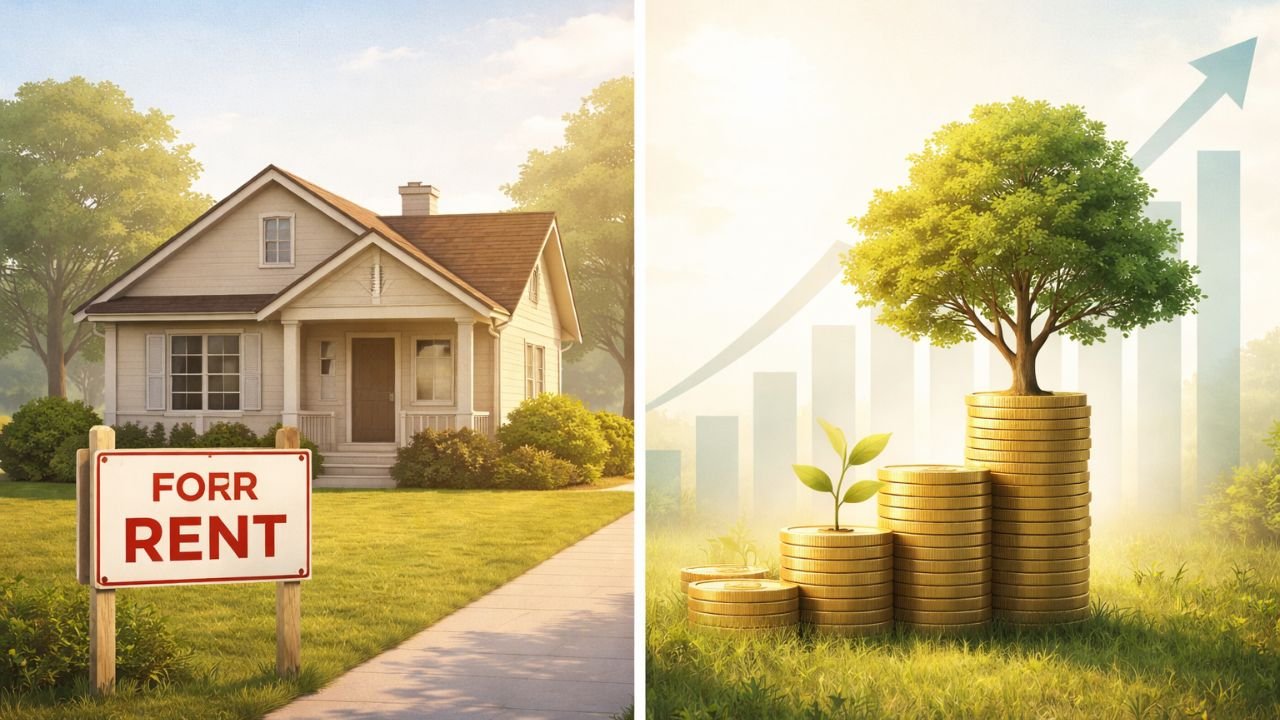
There comes a moment in many people’s lives when money quietly accumulates.
After years of work.
Careful saving.
A sense of “now I should do something meaningful with it.”
And then the question appears:
“Should I build a house for rent… or invest this money?”
It sounds simple.
But hidden inside this question is a deeper choice—
a choice between feeling secure today and becoming truly free tomorrow.
And most people don’t even realise which one they are choosing.
The Comfort That Feels Right
A house is not just an asset.
It is a feeling.
It stands there, solid and visible, reassuring you that your money has taken a permanent shape. When rent starts coming in—even a small amount—it brings a quiet satisfaction.
Every month, something arrives.
Something predictable.
Something real.
And that feeling is powerful.
Because it answers a deep human need:
the need to feel safe.
But Here Is What We Rarely Ask
What if that sense of safety is coming at a hidden cost?
A rental house often gives modest returns—typically around 2–4% annually.
After maintenance, vacancies, repairs, and occasional tenant issues, the real return can be even lower.
But that is not the real issue.
The real question is what your money could have become instead.
When you lock a large amount into a house early in life, you quietly step away from the power of compounding—limiting your money’s ability to grow.
You are not just buying a structure—you are limiting your money’s freedom to grow.
And compounding is not loud.
It does not send monthly rent messages.
It works silently, almost invisibly—until one day, the difference becomes undeniable.
The Invisible Path Most People Ignore
Imagine this:
Suppose you have ₹50 lakh. Instead of tying it up in a structure, you let it grow—quietly, steadily, over time.
No tenants.
No repairs.
No calls at inconvenient times.
Just time… doing its work.
Over 10–15 years, that money can become something far larger—
not dramatically overnight, but steadily, silently.
And one day, without much noise, it reaches a point where:
👉 It can generate far more income than rent ever could
👉 It gives you choices, not obligations
But by then, the moment to choose that path is often gone.
Why Smart People Still Choose the Smaller Path
This is not about the lack of knowledge.
It is about how the mind works.
We are naturally drawn to what we can see.
A building feels safer than numbers on a screen.
Monthly rent feels more real than future growth.
Ownership feels like progress.
And then, without realising it, we begin to copy others.
We see someone build a house and earn rent.
It looks like a clear path.
And a quiet thought forms:
“This is the way. If I have the money, I should do the same.”
And slowly, without realising it, we begin to prefer certainty over possibility.
Even if that certainty is smaller.
Timing Is the Part Most People Miss
A rental house is not a bad decision.
It is often just a mis-timed decision.
If you are 35 or 40, your greatest advantage is not money.
It is time.
This is the phase when money can still grow, multiply, and quietly shape your future.
At 50 and beyond, the equation changes.
Stability and income begin to matter more than growth.
The same rental house that feels limiting at 35
may feel perfectly right at 50.
The mistake is not in choosing property—
it is in choosing it too early.
A Subtle but Important Shift in Thinking
Instead of asking:
“Which option is better?”
Try asking:
“What do I need this money to do for me right now?”
- If you need growth → let it grow
- If you need income → let it serve
When you mix these roles too early,
you often end up with neither enough growth nor enough income.
A Quiet Truth
A house gives you something to hold on to.
But growth gives you something to move forward with.
One creates a sense of arrival.
The other creates the possibility of freedom.
And the difficult part is—
freedom rarely looks impressive in the beginning.
In the End
Most financial decisions are not wrong because of a lack of information.
They are wrong because they are made from a place of comfort instead of clarity.
So before you decide, pause for a moment and ask yourself:
“Am I choosing what feels safe…
or what truly expands my future?”
Because sometimes, the biggest loss is not in making a bad investment…
It is in not allowing your money to become what it could have been.