
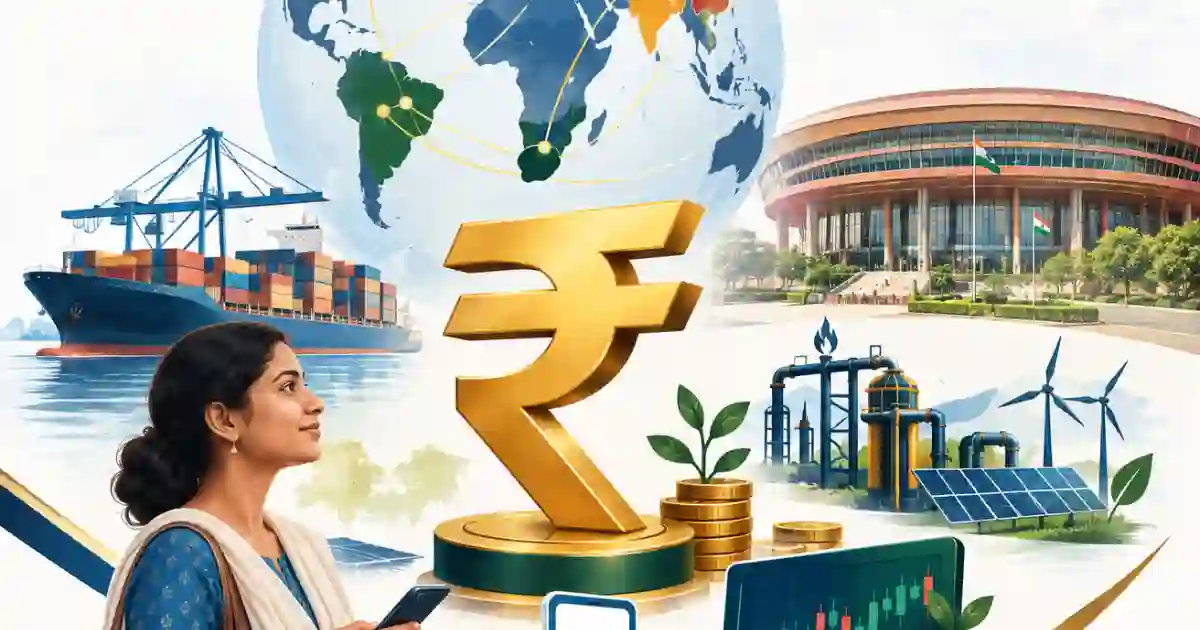
This week, world leaders are gathering at Bharat Mandapam in New Delhi for the 18th BRICS Summit, hosted by India on September 12 and 13, 2026. You’ve probably seen the headlines — the motorcades, the handshakes, the talk of “de-dollarisation” and “strategic partnerships.” And you’ve probably also asked yourself the one question most news reports never bother to answer: what does any of this have to do with my money?
That’s the question this article is built around. Not “what happened at the summit,” but “should I, an ordinary Indian with a salary, some savings, maybe a few mutual funds and a loan EMI to pay, actually care?”
The honest answer is: a little, eventually, and not in the way the headlines suggest. Let’s walk through why.
What Is BRICS? A Quick Primer Before the BRICS Summit 2026
BRICS started in the late 2000s as a name for five large emerging economies — Brazil, Russia, India, China, and South Africa. Over the last couple of years, the group has expanded. The 11 members are Brazil, Russia, India, China, South Africa, Egypt, Ethiopia, Indonesia, Iran, Saudi Arabia, and the UAE.
Together, these nations account for a large share of the world’s population and a substantial slice of global economic output. That scale is exactly why BRICS has moved from being a talking shop for emerging markets to a group whose decisions can nudge trade flows, commodity prices, and financial arrangements around the world.
Keep this section in your back pocket — you don’t need to memorise the member list. What matters is the size and intent of the group, not the roll call.
Why the 18th BRICS Summit in New Delhi Matters for India’s Economy
This year, India holds the BRICS chairship, and the BRICS Summit 2026 is being hosted on home turf, under the theme “Building for Resilience, Innovation, Cooperation and Sustainability.” Over the course of the year, India has hosted hundreds of ministerial meetings and working-group sessions across dozens of cities, building up to this leaders’ summit.
For India, hosting isn’t just diplomatic prestige. It’s an opportunity to push its own priorities onto the agenda — deeper trade cooperation, digital public infrastructure, energy security, and a bigger voice for the Global South in institutions historically dominated by the West. The framing that matters for you is economic, not political: India is using this platform to negotiate better trade terms, cheaper energy access, and financial arrangements that could, over time, benefit Indian businesses and consumers.
Notice the phrase “over time.” That’s the thread running through this entire article.
BRICS Summit 2026 and the Changing Global Economy
Trade Between BRICS Nations
One of the recurring themes at BRICS gatherings, including this year’s summit, is increasing trade between member countries — reducing reliance on any single trading partner or currency, and building more direct commercial relationships between, say, India and Russia, or India and the UAE.
Energy and Commodities in Focus at BRICS Summit 2026
Energy cooperation has had its own dedicated track this year, with senior energy officials and energy ministers from BRICS countries meeting well ahead of the leaders’ summit. Since India imports a large share of its crude oil and natural gas, any BRICS-level arrangement on energy trade — pricing, payment terms, or long-term supply deals — is one of the more direct economic threads connecting the summit to India’s economy.
Deeper Economic Cooperation Among Emerging Economies
Beyond trade and energy, BRICS countries continue to talk about strengthening institutions like the New Development Bank, coordinating on technology and digital infrastructure, and generally presenting themselves as a bloc with growing economic weight. None of this changes overnight. But it does shape the environment Indian businesses operate in over the coming years.
Why does this matter to you? Because trade agreements, energy deals, and financial cooperation eventually show up in things you actually experience — fuel prices, the cost of imported goods, and the fortunes of companies you might hold in your portfolio.
Will the BRICS Summit 2026 Impact the Indian Rupee and USD?
This is the question that gets the most breathless headlines, so let’s be precise about it.
BRICS countries have repeatedly discussed reducing their dependence on a single global currency for trade settlement, and exploring more use of national currencies or new payment mechanisms between member states. This is a real, ongoing conversation — but it is not the same as an announcement that changes the rupee’s value overnight.
Here’s the honest way to think about it: if more trade between India and other BRICS nations eventually gets settled in rupees or local currencies instead of dollars, that could modestly reduce India’s dependence on dollar liquidity for certain transactions over the long run. That’s a possibility, not a certainty, and it’s a slow-moving structural shift, not a summit-triggered event.
The rupee’s day-to-day value will keep being driven mainly by oil prices, foreign investment flows, US interest rates, and India’s own trade balance — not by a joint statement from a summit. Be very wary of anyone telling you the rupee will “rise” or “fall” because of what was announced this week.
BRICS Cross-Border Payment Systems: How UPI and Local Currencies Fit In
A quieter but arguably more concrete thread at the BRICS Summit 2026 is cooperation on cross-border payments. BRICS nations have been discussing ways to make it easier and cheaper to settle payments between member countries directly — linking domestic fast-payment systems, exploring shared settlement platforms, and reducing the friction and cost of moving money across borders.
If this develops meaningfully, it’s genuinely useful, though the benefit shows up slowly: an Indian exporter getting paid by a Russian buyer, or a UAE-based business paying an Indian software vendor, could eventually see faster settlement and lower transaction costs. For everyday consumers, digital-payment cooperation is the kind of thing that improves quietly in the background — you’re more likely to notice it as “wait, that international payment came through overnight” than as a single dramatic change.
BRICS 2026 Investment Guide: Impact on Indian Stocks, Gold & Energy
Break this down by what you might actually hold in your portfolio.
Indian Stocks and Businesses
Companies with meaningful trade exposure to other BRICS nations — particularly Russia, the UAE, and China — could see incremental benefits from smoother trade arrangements. But “could benefit from a trend” is very different from “will rally because of a summit.”
Banks and Financial Companies
If cross-border payment cooperation advances, banks and payment companies involved in international remittances and trade finance are the most directly affected businesses. This is a sector worth watching over the next few years, not the next few weeks.
Energy Stocks
Given how central energy cooperation has been to this year’s BRICS agenda, Indian energy companies — refiners, importers, and those with supply agreements with BRICS partners — are one of the more plausible areas where summit-linked developments could eventually show up in earnings.
Commodities and Gold
BRICS discussions about reducing dollar dependence sometimes get tied to gold demand narratives. Central banks in several emerging economies, including India’s, have been steady gold buyers in recent years for reasons well beyond BRICS. Don’t mistake a summit talking point for the actual driver of gold prices.
Exporters and Importers
Any Indian business that imports from or exports to other BRICS nations has a genuine, if gradual, stake in how trade terms evolve. This is worth tracking if you invest in or run such a business — again, over quarters and years, not headlines.
Currency Exposure
If you hold international funds, have foreign loans, or run a business with import/export exposure, currency movements matter to you regardless of BRICS. Just don’t let a summit-driven headline be the reason you hedge or unhedge that exposure.
Impact on Household Budget: Petrol Prices, Inflation, and Foreign Travel
This is where a MoneyDecider take differs from a standard news report — because most people reading about the BRICS Summit 2026 don’t own energy stocks or run export businesses. They just want to know if their life gets more expensive or less.
Fuel Prices
If BRICS-linked energy cooperation eventually leads to more favourable oil or gas terms for India, that’s a factor which could, over time, ease pressure on fuel prices. It’s one input among many — global crude prices, taxes, and the rupee’s value matter just as much, if not more.
Imported Goods and Inflation
Anything India imports — electronic components, certain machinery, some raw materials — is indirectly linked to how trade and currency arrangements evolve between India and its trading partners, BRICS members included. A meaningful shift here would take months or years to filter into retail prices, not days.
Travel Abroad
If you travel to or do business in other BRICS nations, easier payment systems and any trade-linked currency arrangements could, down the line, make transactions smoother. Don’t expect this to change your next holiday’s budget.
Remittances
For households that send or receive remittances involving BRICS countries, cheaper and faster cross-border payment systems are the most tangible, if gradual, benefit worth watching.
Cost of Products Dependent on International Trade
Broadly, anything with a long global supply chain — from smartphones to certain food products — sits at the end of a chain that trade and currency policy can influence. The BRICS Summit 2026 is one input into that chain, not the only one, and rarely the fastest-moving one.
Should You Change Your Investments Because of the BRICS Summit 2026?
Please don’t rush this.
- Don’t buy a stock simply because a BRICS-linked announcement mentions its sector.
- Don’t assume the rupee will rise or fall because of what was said at the summit.
- Don’t make an investment decision based on a headline you skimmed on your phone.
- Do look at actual economic changes as they unfold — a signed trade agreement, a functioning payment system, a company’s updated guidance — and at the fundamentals of the specific business or asset you’re considering.
Summits produce statements of intent. Markets eventually price in outcomes, not intentions. The gap between the two is exactly where impulsive, headline-driven decisions go wrong.
What Should You Watch After the BRICS Summit 2026? A Practical Checklist
Instead of reacting to this week’s news cycle, keep a simple watchlist for the months ahead:
- Trade agreements — Are specific, binding trade terms actually signed and implemented, not just discussed?
- Payment-system developments — Does cross-border payment cooperation move from pilot programmes to real, usable infrastructure?
- Currency developments — Is there measurable growth in rupee or local-currency trade settlement, tracked over quarters, not days?
- Energy and commodity arrangements — Are there concrete supply or pricing deals with BRICS energy partners?
- Policy implementation — Do government policies actually follow through on summit commitments?
- Actual impact on Indian companies and markets — Are specific, identifiable companies reporting real revenue or cost impacts tied to BRICS-linked trade?
If you can tick off real progress on these over the next year, that’s when it’s worth revisiting your financial decisions — not the week of the summit itself.
The MoneyDecider Lesson from BRICS Summit 2026
Here’s the core idea worth carrying forward, not just for BRICS but for every big international event you’ll read about in the years ahead: a big international event doesn’t automatically require a big financial decision.
Understand what is actually changing. See how it could realistically affect you — your income, your expenses, your investments. Then decide, deliberately, on your own timeline — not on the news cycle’s timeline.
That’s a very different approach from scrolling through summit coverage and wondering if you should panic-buy gold or dump a stock by evening.
Conclusion: BRICS Summit 2026 Is Important, But Patience Pays
The BRICS Summit 2026 is a genuinely significant event — for India’s global standing, for trade relationships among major emerging economies, and for long-term shifts in how global commerce and payments might work. But significant doesn’t mean immediate, and important doesn’t mean urgent.
For most Indian households and investors, the more useful skill isn’t following every political headline coming out of Bharat Mandapam this week. It’s understanding the slow-moving economic threads the summit represents, watching for real, measurable developments over the months ahead, and making financial decisions based on facts on the ground — not on the emotional pull of a big news moment.
Watch. Understand. Then decide. That’s the MoneyDecider way.
Ask Your Money Question
Share your financial dilemma. Your question may become a helpful guide for others too.
About the Author
Naivedyanandan Sonowal is a former teacher and former APDCL professional who now works as a freelance journalist. He writes about real-life money decisions shaped by experience. Having managed loans, debt, and financial responsibilities firsthand, he shares practical insights to help readers think clearly before spending, borrowing, or investing. He is also the author of a book on smart retirement planning, available on Amazon.